Buyers from Germany, Austria, or Switzerland looking for property in the Mediterranean usually ask the same question very early on: is it safe to buy property in Turkey? The short answer is: Yes, the purchase can be safe – but only if the legal due diligence, the property's origin, the contract structure, and the payment processing are professionally handled. The risk isn't the market itself, but rather buying without clear oversight.
For European investors, location and price are not the only factors that matter. Crucially, the entire process must be transparent, well-documented, and legally sound. Adhering to European standards significantly reduces typical errors and lays the foundation for a stable, long-term investment.
Is it safe to buy property in Turkey? The honest answer.
Turkey has been an established market for international buyers for years. Holiday properties, second homes, and high-quality investment properties are professionally developed and sold in many regions. Nevertheless, the question of security is justified because purchase processes, registration practices, and contract details can differ from those in the DACH region (Germany, Austria, and Switzerland).
Security, therefore, does not arise from advertising promises, but from structure. This includes a clean land registry record, the verification of encumbrances, a unambiguous building permitA traceable chain of ownership and a contract that is not only linguistically understandable but also legally sound. Anyone who adheres to these guidelines is not buying blindly in Turkey, but rather with due diligence.
What really matters when it comes to legal security
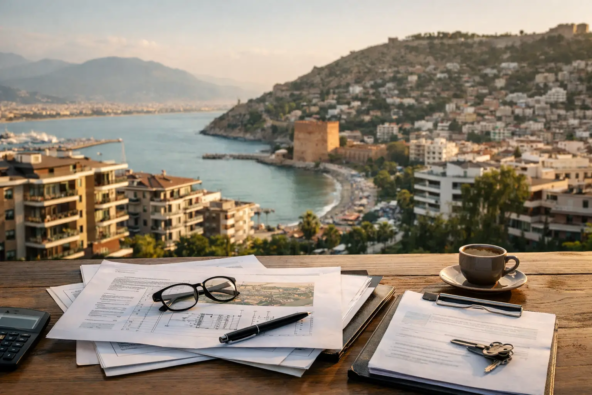
The most important point is proof of ownership. In Turkey, the decisive factor is the Tapu, or land title. Before any purchase decision, it must be verified whether the seller is actually authorized to dispose of the property and whether there are any encumbrances, mortgages, liens, or other entries on the property. A nice property listing is no substitute. this test not.
The building's legal status is equally important. For new builds or newer projects, buyers should carefully check whether the necessary permits are in place and whether the unit's intended use corresponds to the actual construction and division situation. Especially with high-end residential complexes, it's also crucial to understand how common property, property management, utility costs, and technical standards are regulated.
Many risks arise not from prohibited or unsafe transactions, but from imprecise communication. If a buyer doesn't clearly understand exactly what is being purchased, when payment is due, what additional costs will be incurred, and when ownership will transfer, the risk increases unnecessarily. Therefore, every step should be documented, translated, and legally assessed.
The contract is more than a formality
A purchase agreement only serves as a safeguard if its contents are clear and balanced. This includes the exact object of purchase, payment deadlines, transfer conditions, potential penalties, details of inventory and equipment level, as well as provisions for situations where deadlines are missed.
International buyers, in particular, sometimes underestimate the importance of coordinating the preliminary contract, payment plan, and land registry transfer. If these three elements are not properly aligned, uncertainties arise that are difficult to rectify later. Professional guidance provides clarity before any money changes hands.
What risks should buyers realistically plan for?
Anyone asking whether it's safe to buy property in Turkey rightly doesn't expect a blanket reassurance. There are risks – as in any international market. The difference lies in whether they are recognized and managed.
A common issue is the discrepancy between presentation and reality. Not every property with a good location description is automatically a strong investment. The specific micro-location, the construction quality, the future rental potential, the surrounding infrastructure, and the project's target group must all align. A property in the wrong location remains a weaker asset, even with good marketing.
Another important issue is payment processing. Especially with down payments, installment plans, or off-plan purchases, it's crucial to clearly define which service corresponds to which payment step. Anyone transferring large sums without understanding the ownership structure, construction progress, and contract logic unnecessarily increases their risk.
Furthermore, there is the question of long-term management. Buyers should not only consider the purchase itself, but also the period afterward: ongoing costs, administration, use during their own holidays, potential resale, and tax implications in their home country. Security doesn't end with the notary appointment or the transfer of title.
How professional buyers assess a property in Turkey
Experienced investors don't start with emotions, but with a thorough due diligence process. First, the property itself is analyzed: location, year of construction, developer or previous owner, technical quality, and realistic market position. This is followed by a legal review. Only when this stage is clear is in-depth purchase negotiation worthwhile.
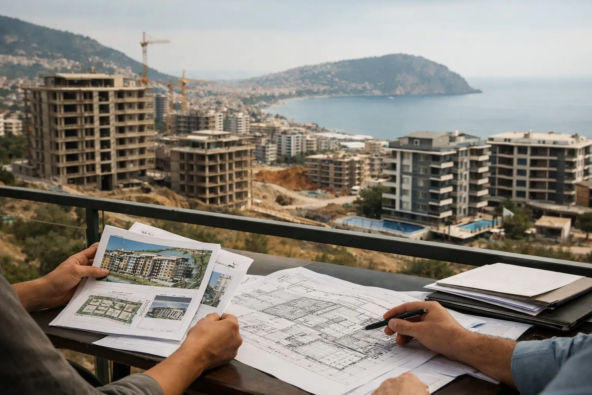
A thorough review of all documents before making a reservation or deposit is particularly advisable. This includes ownership documents, permits, apartment allocation, any encumbrances, and, in the case of projects, verifying that the advertised features match the contractually agreed-upon scope of delivery. The higher the property's value, the less one should rely on verbal agreements.
Is the location merely beautiful or also valuable?
For buyers from the DACH region (Germany, Austria, Switzerland), not every coastal location is automatically attractive. The crucial factors are whether the location remains in demand over the long term, has well-developed infrastructure, and aligns with their personal goals. Someone primarily seeking personal use will have a different valuation than someone prioritizing asset protection, future resale potential, or residency options.
In Alanya, for example, the range is vast. There are locations that are very well suited for a high-quality second home, and others that are more price-oriented and less selectively sought after. This is precisely where the advantage of local market knowledge combined with European consulting methods becomes apparent: not every available property is also strategically sound.
When buying is particularly safe – and when caution is advised
A purchase is generally considered particularly secure when the property has a clear ownership status, all documents are available, the seller is transparent, and the payment structure is comprehensible. A realistic price in relation to the location, construction quality, and market environment also suggests a more sound offer than a conspicuously low starting price without a clear explanation.
Caution is advised if time pressure is applied, documents are only partially provided, or essential points are supposedly to be clarified later. Likewise, one should be wary if contract terms remain unclear or the actual legal situation is obscured by vague sales pitches. A professional market doesn't need smoke and mirrors.
What European buyers often underestimate
Many buyers focus heavily on the purchase price and too little on process quality. However, it's often not the price per square meter that determines security, but the quality of the support provided. Those without clear test Buying this can be a false economy.
The importance of linguistically and culturally accurate communication is also often underestimated. Especially in cross-border transactions, it's not just about translation, but about contextualization. Understanding a document doesn't automatically mean correctly assessing its implications. Therefore, a consultant who is familiar with both the Turkish market and the expectations of buyers from Germany, Austria, and Switzerland is invaluable.
Security is created by a system, not by luck.
The question of whether it is safe to buy property in Turkey can only be answered seriously as follows: Yes, if you buy using a structured approach. Turkey offers attractive real estate markets and professional projects, but safety is not automatic. It is achieved through due diligence, clear contracts, transparent payment methods, and the right choice of property and location.
Those who treat a purchase like a serious investment decision, rather than a spontaneous holiday purchase, are significantly better protected. This is precisely the difference between a risky, impulsive decision and a sound investment in foreign real estate. If you wish to examine the Turkish market with legal precision and local expertise, a German-language consultation process is the most sensible first step – also available via WhatsApp or the contact form if you would like to have specific properties or documents assessed.
Ultimately, it's not about whether a market is generally safe or unsafe. What matters is whether your purchase was properly prepared.