




An apartment is offered at an attractive price, the location fits and the viewing is convincing. Only after the handover of the keys does it turn out that the monthly community fees are higher than expected, a special levy is on the horizon or the furnishing requires a much larger budget. This is exactly where typical cost traps when buying property in Turkey lie: rarely in a single large bill, but often in unclear assumptions made before the purchase.
For international buyers, the asking price is not the only decisive factor. A property in Alanya should also suit your personal usage model after the purchase – as a holiday home, retirement residence, investment or a combination of these. Those who plan costs transparently recognise cost traps when buying property in Turkey earlier, negotiate more calmly and can compare properties realistically.
Why the purchase price is only the start of the calculation
Two apartments with a similar price can be very different financially. One is in a compact complex with limited services. The other is part of a complex with a pool, spa area, security, lifts, well-kept grounds and year-round management. These facilities create quality of life and can appeal to owner-occupiers and tenants alike. But they also cause regular costs.
The key question is not whether a complex has low or high monthly service charges. What matters is whether the scope, allocation and financial planning are transparent. A low fee is no advantage if necessary maintenance is postponed. On the other hand, higher costs are reasonable if services, reserves and management are clearly organised.
So don't just compare square metres, views and distance to the beach. Always ask: what does normal operation cost, what work is coming up, and which services are actually included?
Additional purchase costs: the fees due at transfer of ownership
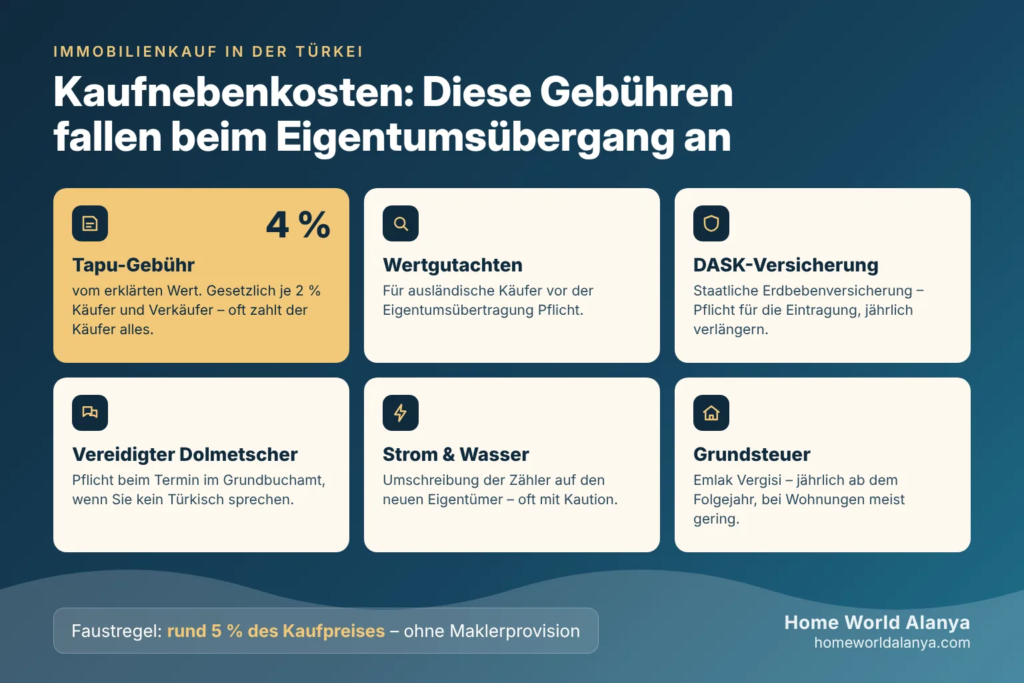
Among the best-known cost traps when buying property in Turkey are the additional costs on the day of the title deed transfer. The title deed (tapu) fee is 4% of the value declared in the land registry. By law, buyer and seller each pay half, but in practice it is often agreed that the buyer covers the full 4%. So clarify this point in writing before you reserve.
There are further items that foreign buyers should know about:
- Valuation report: Foreign buyers must obtain a report from a licensed valuer before the transfer of ownership.
- DASK earthquake insurance: This compulsory state insurance must be in place for the registration and renewed every year.
- Sworn interpreter: If you don't speak Turkish, you need a sworn interpreter for the appointment at the land registry.
- Transfer of utility meters: Electricity and water are transferred to the new owner; deposits may apply.
- Property tax: From the following year, an annual property tax (emlak vergisi) is due, which is usually modest for apartments.
Registration is handled by the Turkish General Directorate of Land Registry and Cadastre (TKGM); information on the compulsory insurance is available directly from DASK. As a rough rule of thumb, budget around 5% of the purchase price for additional costs – not including any agent's commission.
Running costs: what you really pay for in a complex
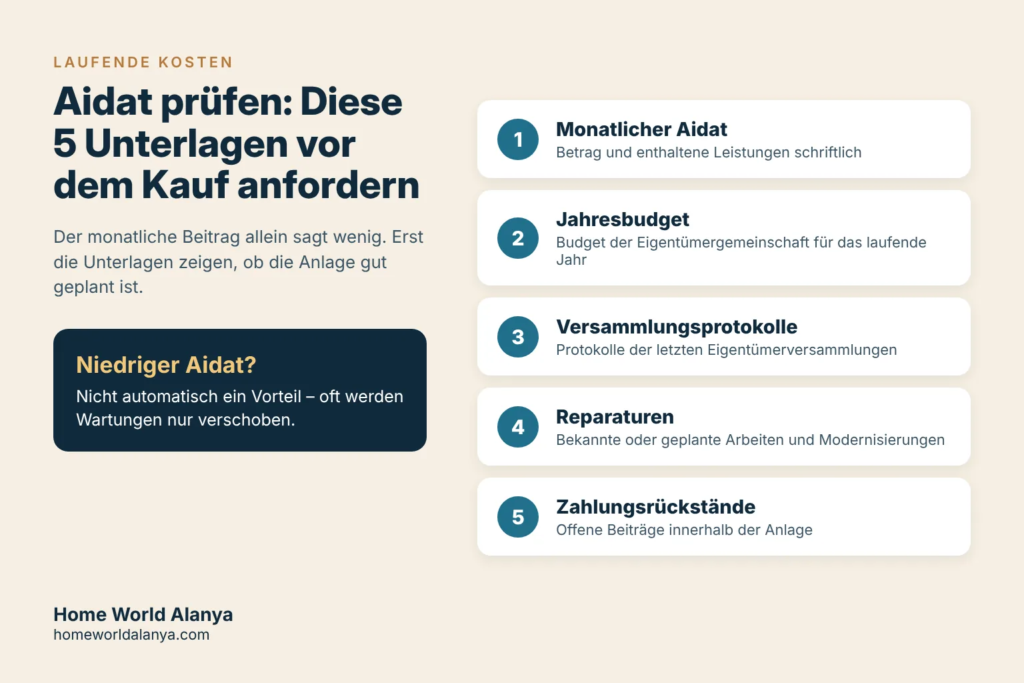
In Turkey, the monthly service charge is usually called aidat. It can vary widely from complex to complex. What counts is not only the number of apartments, but also the facilities, staff, year-round use and maintenance needs.
A complex with an outdoor pool, indoor pool, gym, sauna, generator, CCTV, several lifts or 24-hour security has different operating costs from a small building without communal areas. A shuttle service, if offered, should only be part of your calculation if its funding and duration are clearly documented.
Don't settle for a verbal explanation of the current costs. These documents are particularly helpful for a sound decision:
- the current monthly fee and the services it includes,
- the owners' association budget for the current year,
- minutes of recent owners' meetings,
- known or discussed repairs and upgrades,
- information on payment arrears within the complex.
Such a check does not replace individual legal advice. But it shows early on whether the running costs fit your plans. For a buyer who only spends a few weeks a year on site, service and support can make sense. Anyone who wants to live in Alanya permanently will probably pay more attention to stable long-term running costs and a well-functioning owners' association.
Don't treat special levies as a side issue
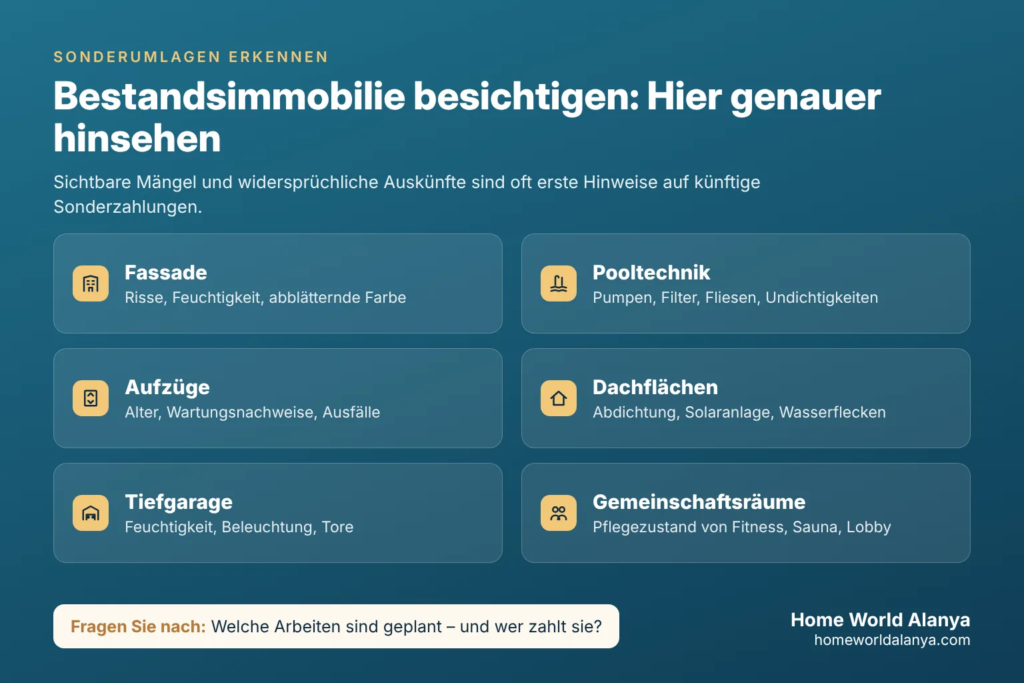
When major work on communal areas, technical systems or the building is due, extra payments may be required. Special levies are not automatically a reason to walk away – a well-kept property needs maintenance. It becomes a problem when works are announced late, there is no clear cost plan, or a backlog of repairs is hidden behind an unusually low aidat.
With resale properties it is therefore worth looking at visible areas such as the façade, pool equipment, lifts, roofs, underground car park and communal rooms. Not every technical question can be fully answered during a viewing. But visible defects, poor upkeep or contradictory answers are signals to ask more questions and not to look at the price in isolation.
Cost traps when buying property in Turkey: furnishing and handover
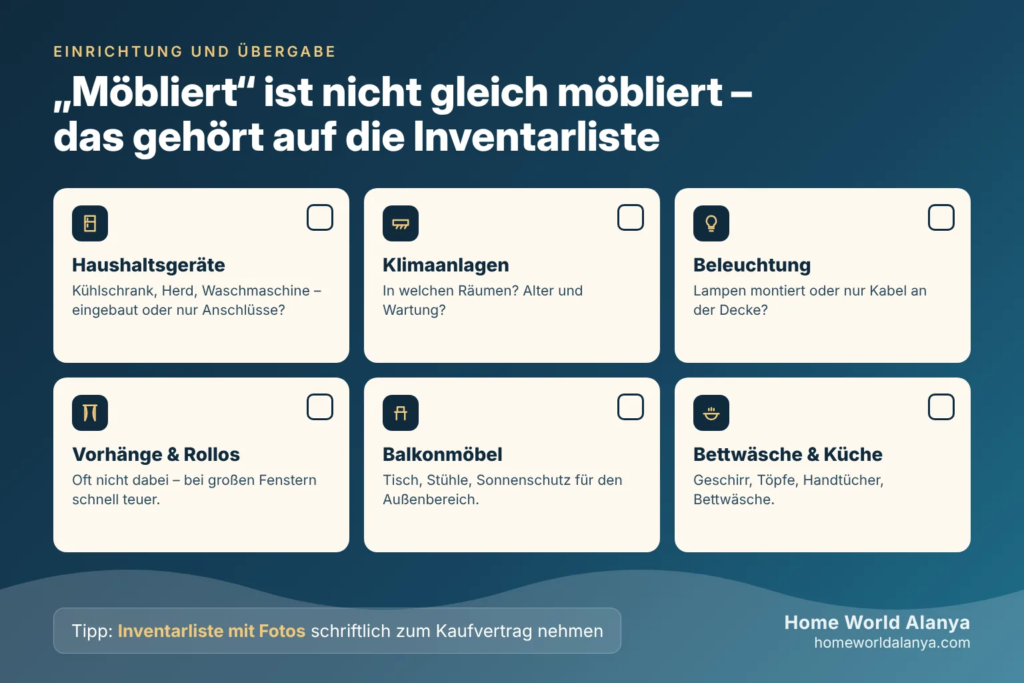
Miscalculations are especially common with furnished properties and new builds. “Furnished” can mean a complete apartment that is ready to use. But it can also mean that some furniture is there, while appliances, lighting, air conditioning, curtains or balcony furniture have to be arranged separately.
So have it put in writing which items are part of the sale. An inventory list with photos creates clarity. This matters especially for a holiday home: if you are only on site for a few days after the handover, you don't want to be hunting for replacements or coordinating tradespeople at short notice.
With new builds the focus is different. It should be clear which standard of fittings is owed under the contract and which services are offered as an optional package. A show apartment can give design ideas, but it is not automatically identical to what is included in the unit you buy. Ask specifically about materials, built-in appliances, air conditioning, kitchen units and connections.
A realistic furnishing budget includes not only furniture but also smaller, unavoidable items: kitchenware, bed linen, outdoor furniture, internet hardware, decoration, spare keys and, if needed, the initial set-up on site. Each item seems small, but together they quickly add up to a significant amount.
Plan exchange rates and payment methods carefully
Many European buyers think in euros, while some expenses are paid in Turkish lira. This typically applies to running costs, services, furnishing or work by tradespeople. Exchange rates can change, so a calculation based on a single day's rate is not a reliable annual plan.
It makes sense to keep a separate buffer for expenses in local currency. How large it should be depends on how you use the property. Someone who lives there has different running costs from a buyer who only visits occasionally. With rented properties, too, you should distinguish between expected income and money actually available. Vacancies, repairs and seasonal swings belong in every cautious calculation.
The payment method matters just as much. It is not only the transfer amount that counts, but also possible bank charges, conversion terms and the clear allocation of every payment to the purchase. Clear payment schedules and proper receipts prevent misunderstandings. If several parties are involved, the payment process should be fully clarified before any binding commitment.
Own use, renting out or empty periods: the cost question changes
An apartment meant only for your own family is assessed differently from a property bought to rent out. For own use, comfort, accessibility and reliable care while you are away come first. If you buy as an investment you also have to consider marketing, guest changeovers, cleaning, coordinating repairs and the legal rules for the type of rental.
The most common mistake is assuming the property will either always be used by you or rented out without a break. In reality there are gaps, maintenance and changes of plan. So don't plan with maximum occupancy, but with a scenario that still works if the property is used less.
Professional management can reduce the effort, but it is not a one-size-fits-all solution. What matters is the scope of services, response times, handling of damage and transparent accounts. If you live outside Turkey, settle these points before buying – not when a problem arises.
How to compare two offers fairly
A sensible comparison starts with an overall view of the first year. Next to the purchase price, write down the regular service charges, expected furnishing costs, planned services, a reserve for the unexpected and your personal use. For a resale property, also check whether repairs or works are due soon.
Take two comparable apartments: the first looks cheaper, but is incompletely furnished and its maintenance needs are unclear. The second costs more, but has documented running costs, a complete handover list and working management. Which one is better value cannot be read from the price per square metre. It depends on how much extra effort actually arises after the purchase and how you plan to use it.
Especially with attractive offers, it pays to include all additional costs – because many cost traps when buying property in Turkey do not arise with the price, but afterwards. Transparency is no obstacle to a quick purchase; it is what stops speed from turning into a wrong decision.
Checklist: 7 cost traps when buying property in Turkey at a glance
- Title deed fee not clarified – who pays the 4%?
- Aidat underestimated – services and annual budget of the complex not checked.
- Special levies overlooked – upcoming repairs not asked about.
- “Furnished” not defined – no inventory list with photos.
- New-build fittings unclear – show apartment confused with what is in the contract.
- Exchange rate ignored – no buffer for costs in lira, bank charges forgotten.
- Full rental income assumed – vacancies and management costs not included.
If you check these seven points before reserving, you avoid most cost traps when buying property in Turkey before they cost you money.
Ask the right questions before reserving
The best protection against cost traps when buying property in Turkey is complete information, not time pressure. Before reserving, ask for a clear breakdown of the running costs and for clarity on any known special issues in the complex. For furnished properties, check the inventory; for new builds, the agreed fittings. And set your own budget for the time after the key handover.
Home World Alanya helps buyers assess offers in Alanya not only by location and price, but also by a documented overall calculation. Feel free to bring two or three specific properties to a consultation – often it is only a direct comparison that shows which costs can be planned long-term and which questions are still open before you decide.
FAQ: cost traps when buying property in Turkey
How high are the additional costs when buying property in Turkey?
Expect around 5% of the purchase price for the title deed fee, valuation report, DASK insurance, interpreter and meter transfer – plus any agent's commission.
Who pays the title deed fee?
By law, buyer and seller pay 2% each. In practice, the buyer often pays the full 4%. What counts is what is agreed in writing.
Is a low aidat a good sign?
Not necessarily. A very low fee can mean that maintenance is being postponed. Check the budget and minutes of the owners' association.


