
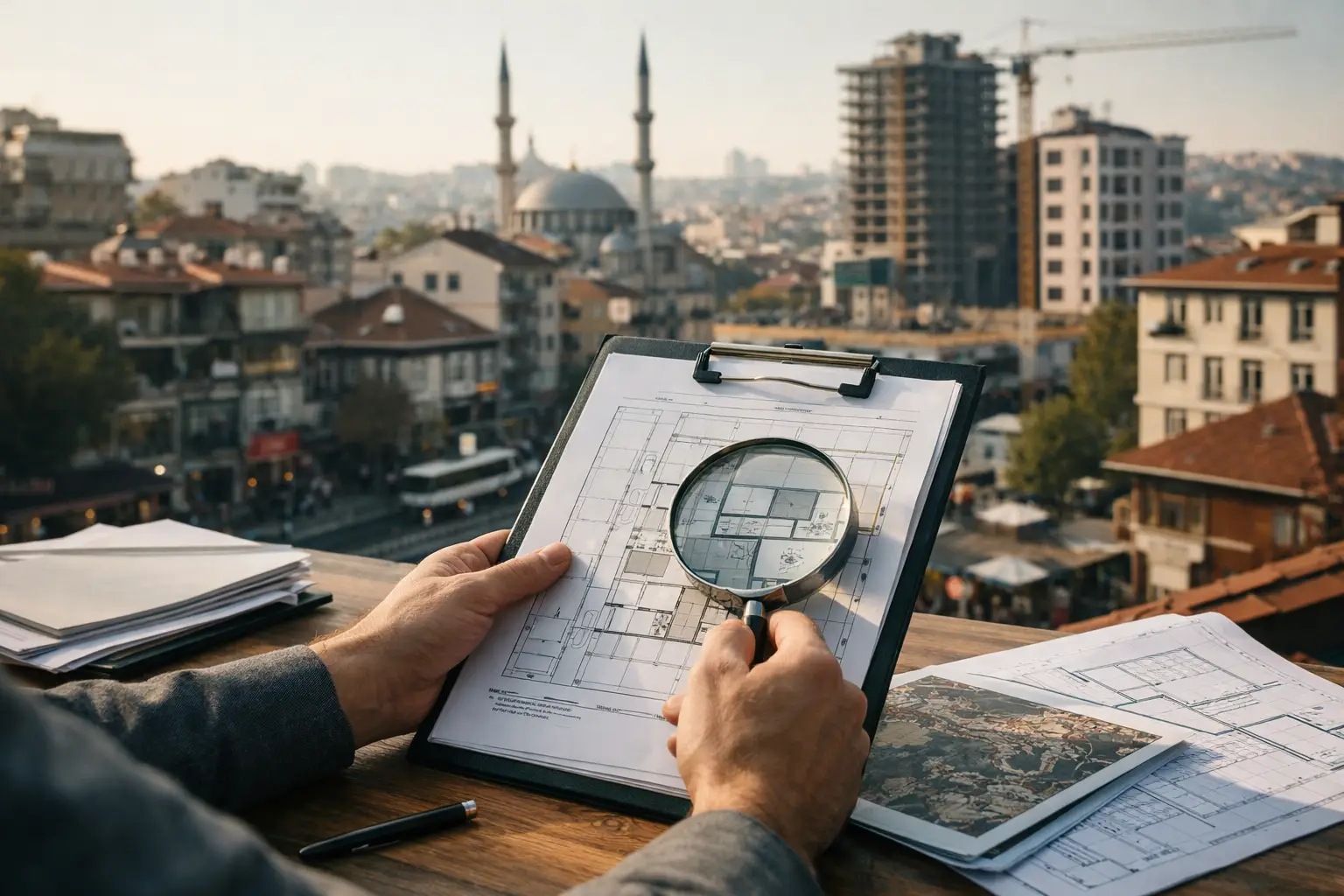
Anyone buying property in Turkey should not treat the Tapu (title deed) as a mere formality before purchasing. Especially for buyers from Germany, Austria, and Switzerland, this document determines whether ownership, usage rights, and any encumbrances are clearly and legally verifiable. An attractive price or a fantastic beachfront location in Alanya is no substitute for a thorough inspection. Our daily experience tells us that a beautiful sea view is utterly useless if the underlying paperwork isn't completely in order. Unfortunately, we repeatedly see buyers who are blinded by initial visual impressions and underestimate the bureaucracy involved.
What does it mean to analyze the Tapu before buying?
The tapu is the official title deed a property in Turkey. It documents who legally owns the property and to which plot of land or unit the ownership refers. For foreign buyers, it is often the most important single document in the entire purchase process – but only if it is read correctly and checked in conjunction with the other documents.
The crucial point is this: a title deed alone doesn't tell the whole story. It confirms ownership, but not automatically that every structural situation, every use, and every contractual agreement is identical to that ownership. This is precisely where many misunderstandings arise in practice. Those who only look at the title sometimes overlook open questions regarding encumbrances, area specifications, or permitting status.
Check the Tapu before buying – these points are crucial
When checking a title deed (Tapu) before buying, it's not just about the owner's name. The first step should be to verify that the seller and the registered owner are the same person. With property developers, heirs, powers of attorney, or corporate structures, particular care is needed to ensure that the rightful owner is actually the one selling the property.
Equally important are the exact details of the property. The plot number, block number, independent unit number (building number), and type of use must match the property you viewed precisely. Herein lies a real pitfall that we often see on the market: In large residential complexes in regions like Alanya, the developer's internal project or apartment number almost never matches the official numbers in the land registry! Anyone who isn't careful here could end up buying the ground-floor apartment facing north, even though they thought they were signing up for the fantastic penthouse view on the 5th floor. Such discrepancies are not oversights, but in the worst-case scenario, they can be the deciding factor in a purchase.
Another key point is registered encumbrances. These include, for example, mortgages, attachments, restrictions on disposal, or other legal entries. Not every encumbrance makes a purchase impossible. However, every encumbrance alters the risk assessment and must be clearly understood and clarified before the purchase.
Finally, it should be determined what type of ownership exists. In Turkey, there are distinctions between land ownership, condominium ownership, and arrangements related to construction progress or occupancy status. This is relevant for investors and owner-occupiers because it allows for conclusions to be drawn regarding legal certainty, financing, and future saleability.
Why supporting documents are crucial when checking the Tapu before purchase
A thorough examination doesn't end with the tapu (the deed). In many cases, further documents, such as building permits, are required for a legally sound classification. Usage permitsCadastral information and details from the management or housing complex are required. Only the interplay of these documents reveals whether the property exists and is used as advertised.
This is particularly important for new builds, project sales, and renovated existing properties. If the floor plan, actual use, and land registry information don't align perfectly, this can become apparent later during sales, rentals, or official procedures. Therefore, discerning buyers should always read documents in context, never in isolation.
Common mistakes when checking the Tapu on your own before buying
Many international buyers blindly rely on beautiful translations, hastily sent WhatsApp photos of documents, or verbal promises over a friendly cup of tea along the lines of, "We'll fill that in later, just make the deposit first." This is understandable, as one wants to build trust in a relaxed holiday atmosphere, but it's absolutely negligent when buying real estate. A title deed (Tapu) must be understood not only linguistically, but also legally and practically. A literal translation rarely explains which entries in the Turkish system are truly relevant. Once money has been blindly transferred via Western Union or in cash before the documents have been checked by the authorities, you'll be left scrambling to find yourself chasing after your assets in a worst-case scenario.
A common mistake is assuming that a quick registration automatically guarantees complete legal certainty. In reality, the entire process is crucial: who is selling, what powers of attorney exist, what encumbrances are involved, whether payments are aligned with the transfer of ownership, and whether all property details are consistent. Legal certainty is not achieved through speed, but through thorough verification.
Focusing solely on the purchase price is also risky. Especially in the high-end segment, experienced investors pay more attention to intrinsic value, exit potential, and the quality of documentation than to the lowest possible discount. A property with a clear and well-documented record is often a better choice than a seemingly cheap purchase with unresolved legal issues.
What risks can checking the Tapu before purchase prevent?
The examination of the title deed (Tapu) primarily serves to reduce risk. It helps to identify ownership uncertainties early on, before payments are made or contracts are signed. This applies not only to fraud risks, but also to everyday problems such as incorrect property classifications, unclear encumbrances, or discrepancies between the property listing and the land register.
For investors from the DACH region (Germany, Austria, Switzerland), another point is crucial: predictability. Those who acquire a holiday home, a second residence, or an investment property want to be able to sell, transfer, or restructure it within the family later without unnecessary complications. A documented, professionally supervised due diligence process provides the foundation for this.
Especially when residency issues, asset structure, or succession planning are involved, the purchase process should not be improvised. The title deed (Tapu) is then not just proof of ownership, but part of a larger financial decision.
This is how a professional examination works in practice.
In practice, the review begins with identifying the property and the seller. The title deed (Tapu) is then examined for content and compared with the information from the sales conversation, the property listing, and other documents. Any irregularities are not overlooked but investigated thoroughly – for example, by reviewing registry data, building plans, or project-related documentation.
The next step is to assess which issues need to be resolved before the contract is finalized. This can vary significantly depending on the property. For an existing apartment with a clear history, the process is usually straightforward. Project developments, commercial units, or more complex ownership structures often require considerably more coordination.
The strict order we adhere to at Home World Alanya is also crucial: first, review; then, finalize the contract; then, pay. Reversing this process unnecessarily increases your risk. For us, professional support therefore means not just checking paperwork, but managing the entire process. Things are often hectic at government offices; appointments must be correctly requested in the system (WebTapu), and the funds must be secured and transferred precisely at the moment of signing. We ensure that no unpleasant surprises arise at the actual appointment at the land registry office that could derail the entire purchase.
When special caution is required
Increased vigilance is advisable if a property is offered significantly below market price, if multiple parties are involved in the sale, or if general powers of attorney are used. Newly completed projects, subsequently altered floor plans, or combined residential and commercial uses should also be examined more closely.
This doesn't mean that such situations are necessarily problematic. But they do require more in-depth examination. Those who work meticulously in these cases can seize good opportunities. Those who take shortcuts also buy uncertainty.
For foreign buyers, structure is of primary importance.
The Turkish real estate market offers interesting opportunities, but security lies in the execution. European buyers rightly expect clarity, reliability, and transparent processes. That's precisely why the question of whether to check the title deed (Tapu) before buying isn't really an open question – it's a standard part of any serious purchase decision.
Those who proceed professionally pay attention not only to location, amenities, and price, but also to the legal validity of the acquisition. This is not a bureaucratic add-on, but rather... Part of asset protection. Especially in regions with international buyer interest, such as Alanya, it is repeatedly shown that good properties are convincing not only visually, but also in their documentation.
If you're looking to have a property in Turkey inspected, the service should be German-speaking, locally based, and legally sound. Home World Alanya combines precisely this approach with local market knowledge and a clearly structured inspection process. It's best to have documents reviewed before making a reservation or deposit – this way, you can make decisions based on facts, not assumptions.
A good purchase doesn't begin with the notary appointment, but with asking the right questions at the right time.
Additional information on official registrations and procedures can also be found directly at [website/organization name]. Turkish land registry office.