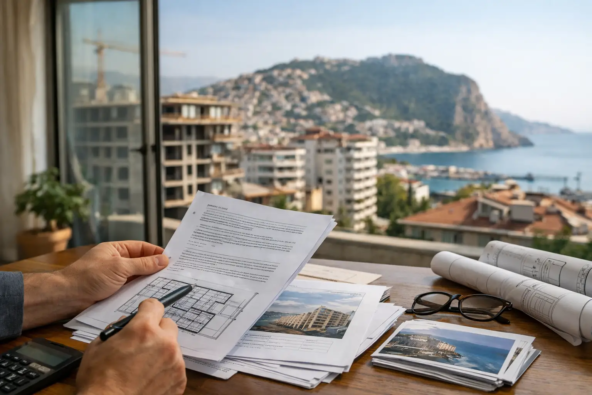

A purchase agreement may be carefully reviewed and the desired property may be convincing – nevertheless, financing often determines whether a purchase in Turkey remains economically viable. In the case of the Real estate financing in Turkey Buyers from Germany, Austria, and Switzerland should not only focus on the purchase price. Currency, payment date, contract terms, and the source of funds are equally important factors in their decision.
Especially in Alanya and the Antalya region, properties are often purchased with a higher equity stake than comparable properties in Central Europe. This is not a disadvantage, but it does require realistic liquidity planning. The best solution depends on your personal asset structure, the property itself, the construction progress, and the intended use.
Real estate financing options in Türkiye: Overview
In practice, four options are available to foreign buyers: purchasing with their own funds, installment payments to the developer, a loan from a Turkish bank, or financing in their home country, secured, for example, by existing assets or real estate. Often, a combination of both is advisable, such as using equity for the purchase and a separate reserve for furnishings, closing costs, and the initial period after handover.
None of these options is inherently better. A buyer with readily available liquidity will prioritize different criteria than someone whose capital is tied up in their home country. For new construction projects, a clearly defined payment plan may be appropriate. However, for an existing, move-in ready property, prompt and transparent payment is often more practical.
Purchase using equity funds: clear and predictable
Purchasing with equity capital is the most transparent solution for many international buyers. It reduces dependence on credit decisions, interest rate changes, and additional collateral. Furthermore, the timeline for contract, payment, and title transfer is usually easier to coordinate.
However, it's important not to allocate the entire amount solely to the purchase price. Consider closing costs, potential fees, a reserve for repairs or furnishings, and ongoing property costs. For apartments, these include, for example, Aidat payments for common areas, elevators, pools, or security services. The amount varies depending on the property and should be documented before making a decision.
For cross-border payments, traceable processes are more important than speed. The payment procedure should be clearly described in the contract: recipient, amount, currency, due date, purpose of the payment, and conditions for the transfer of ownership. Bank statements and the currency documentation required by applicable regulations should be kept in an organized manner.
Installment payments with a property developer: only with a legally sound contract.
For select new construction projects, developers offer installment payments over a defined period. This can ease your cash flow if the down payment, interim installments, and final payment align with your budget and the actual construction progress. However, such an agreement is not bank financing. Therefore, the project's risk and the quality of the contract documents deserve special attention.
A professional payment plan not only specifies deadlines but also clearly defines payment triggers. Efficient elements include transparent construction phases, a precise property description, and provisions for delays, changes to the specifications, and handover. Do not pay based on a verbal agreement or a non-binding presentation. What matters is what is stated in the contract and whether the documents relating to the property, the project, and the building permit have been reviewed.
Before making any major payment, buyers should compare the development status with the contractual obligations. When purchasing a project, the Tapu status of the propertyPotential liabilities, the planned Iskan situation, and the ownership structure are key points of the due diligence. A favorable payment plan does not compensate for a lack of legal clarity.
Bank loans in Turkey: possible, but must be assessed individually.
Some Turkish banks grant real estate loans to foreign buyers under certain conditions. These requirements vary depending on the bank, nationality, income, property type, loan-to-value ratio, and currency. Interest rates, loan terms, required documentation, and maximum loan amounts can also change. Therefore, loan approval should never form the basis of a binding purchase agreement before a thorough preliminary assessment has been completed.
Banks typically review your income and assets, the property documentation, and the appraised value of the property. Expect translations, additional documents, and processing time. A loan can be worthwhile if it fits your income situation and the monthly payments remain manageable even with fluctuating exchange rates.
Particular caution is advised when taking out financing in a currency other than your regular income. Those who earn in euros and incur obligations in Turkish lira bear an exchange rate risk. Conversely, euro payments from Turkey can also lead to discrepancies when financing is also denominated in euros. This question should be answered with a concrete budget calculation before signing any agreement, not with a general market opinion.
Financing in the home country and capital structure
Some buyers finance part of the purchase price using existing real estate, a securities portfolio, or a line of credit in their home country. The advantages can lie in familiar banks, a known credit check, and financing in their own income currency. However, these advantages are offset by potential collateralization of personal assets, bank fees, and the question of whether the loan term suits the intended use of the Turkish property.
This solution should be considered separately from the Turkish purchase process. A European credit institution assesses risk differently than a Turkish bank and does not automatically accept a property in Turkey as collateral. Therefore, clarify early on what collateral is actually required and when the funds will be available. A purchase price that can only be financed within very tight timeframes increases the pressure at a stage where thorough document review should be the priority.
Secure payment structure before the Tapu date
Financing is only properly organized when it aligns with the transfer of ownership. Before the title deed (Tapu) appointment, the purchase agreement, payment plan, owner details, any existing encumbrances, and the necessary property documents should be finalized. For existing properties, it is also essential to verify that the seller is indeed authorized to dispose of the property and that the information in the title deed matches the agreed-upon property.
The Iskan document also deserves attention. This document is relevant for the use of a building, its utility connections, and its future marketability. Whether an Iskan exists and which documents are required for a specific property should not be assumed automatically, but rather checked on a case-by-case basis. For apartments in a complex, the division, management, ongoing obligations, and outstanding payments should also be examined.
Payments should not be made unnecessarily early or unclearly. A structured process provides protection: review documents, define contract terms, confirm payment methods, and coordinate the transfer of ownership. At Home World Alanya, we support buyers in German from the initial property inspection through contract and payment coordination to the handover of keys, and beyond if desired.
Frequently asked questions about real estate financing in Turkey
Does a property in Turkey have to be paid for entirely in cash?
No. Many buyers use their own funds, but depending on the situation, developer installments, Turkish bank loans, or financing in their home country may be options. The decisive factors are individual circumstances and a thorough due diligence process before signing a contract.
Which documents are particularly important for an installment purchase?
The contract should clearly define the property, purchase price, currency, installments, due dates, construction progress, features, handover date, and consequences of delays. Additionally, property and project documentation must be reviewed.
When should the financing be secured?
Ideally, this should be done before a binding reservation or deposit is agreed upon. This allows enough time to properly coordinate payment deadlines, documents, and the planned transfer of title.
A sound financing arrangement primarily achieves one thing: a calm and predictable purchasing process. Those who carefully combine liquidity, contract terms, and property documents before the first payment make decisions not under time pressure, but on a transparent and well-founded basis.